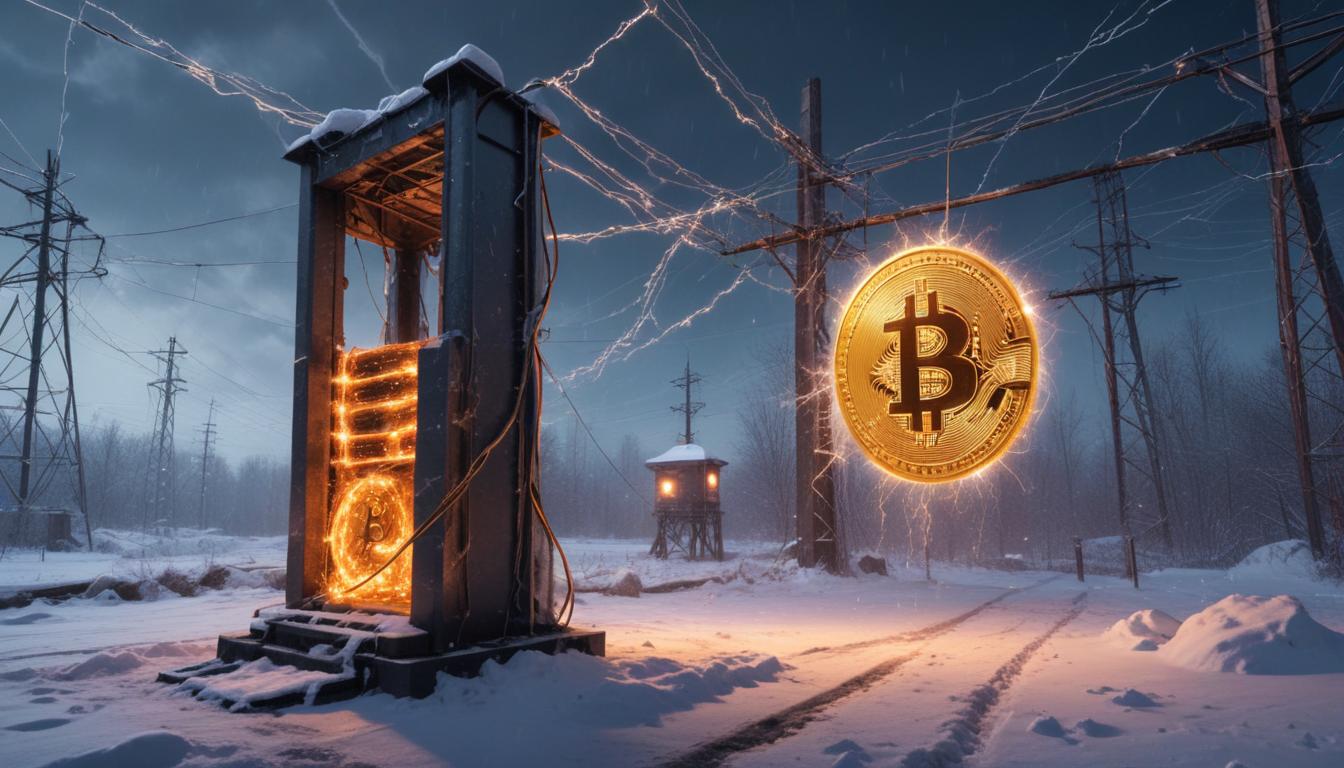
Winter Storm 'Fernan': The Immediate Impact on Bitcoin's Hashrate
The recent onslaught of Winter Storm 'Fernan' across key regions of the United States delivered a swift and undeniable shockwave through the global Bitcoin network. At the forefront of this impact was Foundry USA, which holds the distinction of being the world's largest Bitcoin mining pool. As the storm unleashed its full might—bringing with it formidable freezing temperatures, widespread heavy snowfall, and relentless powerful winds—the integrity of energy grids across multiple states came under severe duress. This critical situation precipitated widespread power outages and strained vital infrastructure. In a commendable response aimed at stabilizing the grid and safeguarding essential services, numerous US-based Bitcoin mining operations, including those contributing to Foundry USA's significant hashpower, proactively opted to curtail their energy consumption. This concerted, albeit temporary, reduction in power usage inevitably led to a substantial decline in the network's overall computational power, a crucial metric for Bitcoin's health.
Foundry USA's Hashrate Plunge and the Ripple Effect on Block Times
The immediate and most direct consequence of these strategic power curtailments became strikingly apparent in the dramatic reduction of hashrate originating from Foundry USA. Since Friday, this prominent mining pool witnessed an estimated 60% decrease in its contribution to the network's computational power, translating into a significant loss of approximately 200 exahashes per second (EH/s). Such a substantial drop is far from a mere statistical blip; it carries tangible implications for Bitcoin's block production schedule. With a considerable segment of the global hashrate temporarily offline, the time required to mine new Bitcoin blocks has visibly extended. Average block times have now stretched to roughly 12 minutes, a notable deviation from the network's intended 10-minute target.
Foundry USA's dominant share of the global hashrate underscores a vital interconnectedness: large-scale mining operations are intrinsically linked to regional energy grids. This event serves as a stark, real-time illustration of how localized phenomena, such as extreme weather, can trigger a cascading effect across the supposedly decentralized Bitcoin network. It initiates a crucial dialogue about the evolving relationship between industrial-scale Bitcoin mining and its emerging role in supporting grid stability during environmental crises. Simultaneously, it raises pertinent questions regarding the resilience and operational fluidity of a network whose hashrate concentration is increasingly anchored within North America, subjecting it to regional vulnerabilities.
Bitcoin Miners: Powering Grid Resilience Through Strategic Demand Response
The notable curtailment of hashpower, exemplified by entities like Foundry USA during severe weather events such as Winter Storm 'Fernan,' isn't merely a reactive measure against adverse conditions. Instead, it underscores a sophisticated evolution in energy management: Bitcoin miners are increasingly pivotal participants in "demand response" programs. These voluntary, yet crucial, agreements enable large-scale energy consumers like mining farms to rapidly reduce their electricity draw when regional power grids face immense strain, such as during periods of extreme weather, unexpected infrastructure failures, or critical peak demand surges.
By stepping into the role of flexible load participants, these miners offer an invaluable service to utility providers and, by extension, the broader community. Rather than being a static, continuous drain on resources, they transform into a dynamic, controllable asset. Their ability to temporarily power down energy-intensive ASIC (Application-Specific Integrated Circuit) equipment frees up substantial amounts of electricity. This strategic curtailment directly fortifies grid stability, ensuring that vital power remains available for residential heating, cooling, critical infrastructure (like hospitals and emergency services), and other essential public needs when the system is most vulnerable. It's a testament to the innovative ways the Bitcoin ecosystem is integrating with and contributing to real-world energy solutions.
The Nuanced Implications of Grid Integration: A Double-Edged Sword for Bitcoin's Decentralization
This active engagement in demand response programs presents a fascinating and somewhat paradoxical dynamic for the global Bitcoin network. On one hand, it showcases the remarkable adaptability and economic incentive structure inherent within industrial Bitcoin mining. The tangible benefits for regional energy infrastructure are clear: the ability to tap into flexible mining loads can prevent cascading blackouts, reduce the strain on costly and often less environmentally friendly "peaker plants" (which are brought online only during peak demand), and enhance overall grid resilience. This positions Bitcoin mining not just as a consumer, but as a strategic partner in energy management.
However, this growing integration also introduces critical considerations concerning the network's foundational principle of decentralization. When a substantial segment of the global hashrate, particularly from prominent pools like Foundry USA, becomes concentrated within specific geographic regions—and thus subject to common external factors such as localized grid constraints, weather phenomena, or even regional energy policies—it inherently raises questions about the diversity of the network's operational footprint. While miners contributing to regional energy resilience is undeniably a positive development from an energy infrastructure perspective, this interconnectedness highlights a potential vulnerability. An amplified impact of future localized disruptions on the broader Bitcoin network becomes a legitimate concern. For investors and network stakeholders, understanding this trade-off between local energy optimization and global network decentralization is paramount, shaping how we perceive the long-term robustness and distribution of Bitcoin's security.
Bitcoin's Unwavering Core: The Algorithmic Resilience of Difficulty Adjustment
In the dynamic world of cryptocurrency, external shocks are inevitable. While events like Winter Storm 'Fernan' can momentarily disrupt segments of the Bitcoin network's processing power, the true genius of Bitcoin lies in its foundational, self-correcting mechanisms. At the very heart of this unparalleled resilience is the difficulty adjustment protocol, a core tenet of Bitcoin's design that shields it from volatility and ensures its long-term operational integrity.
Decoding How Bitcoin's Difficulty Adjustment Maintains Network Stability
This sophisticated algorithm isn't merely a feature; it's the network's invisible hand, diligently working to maintain a consistent block mining time of approximately ten minutes. Here’s how this critical mechanism operates:
- Regular Recalibration: Approximately every two weeks, or precisely every 2016 blocks, the entire Bitcoin network automatically recalculates the mining difficulty. This period is long enough to observe trends but frequent enough to adapt to significant changes.
-
Hashrate-Driven Adaptation: The adjustment is directly proportional to the network's total computational power, known as hashrate.
- Increasing Difficulty: If the collective hashrate has surged, causing blocks to be found faster than the target ten-minute interval, the network automatically increases the mining difficulty. This makes it harder for miners to find the next block, slowing down block production back to the desired pace.
This autonomous recalibration is more than just a technical detail; it's a foundational pillar upholding Bitcoin's trustworthiness. It ensures that regardless of temporary disconnections by miners, shifts in energy markets, or even geopolitical events, the network consistently adapts. For investors, this mechanism offers profound confidence. It guarantees the predictable issuance of new bitcoins, aligning perfectly with its established monetary policy and halving cycles. Furthermore, it underpins the unwavering security and finality of transactions over the long term, preventing prolonged network congestion or instability. This intrinsic self-healing capability cements Bitcoin's status as a robust, reliable, and truly decentralized financial system, capable of enduring and recovering from a myriad of external pressures without human intervention.
Geographic Concentration and the Shifting Landscape of Bitcoin Mining
The recent hashrate fluctuations during Winter Storm 'Fernan', marked by significant curtailment from major players like Foundry USA, underscore an accelerating trend: Bitcoin mining's increasing geographic concentration in North America. This shift presents a complex duality, offering both distinct advantages and notable systemic risks for the network's long-term health and decentralization.
On one hand, this North American consolidation fosters robust integration with regional energy grids. Miners actively participate in demand-response programs, swiftly reducing operations to stabilize grids during peak stress or extreme weather. This strategic participation benefits energy providers by preventing outages and positions miners as essential partners in grid resilience, enhancing their social license to operate.
However, this concentration simultaneously heightens vulnerabilities for Bitcoin's network decentralization. A substantial portion of global hashrate clustered in one region becomes disproportionately susceptible to localized disruptions. Severe weather events or regional policy shifts can trigger cascading effects, impacting global hashrate and potentially affecting transaction confirmation times. This underscores the critical need for a more diversified geographical distribution of mining power to truly safeguard the network's resilience and its foundational principle of decentralization against localized shocks.
Future Outlook: Recovery and Evolving Mining Strategies
As conditions stabilize and infrastructure recovers, a progressive return of curtailed mining capacity is anticipated. This restoration of hashrate testifies to Bitcoin's inherent ability to self-correct and adapt to temporary operational disruptions, a mechanism crucial for its enduring stability.
Moving forward, the industry's strategic focus will intensify on developing resilient infrastructure and embracing diversified energy sourcing. While demand response proves valuable for grid stability, the trend toward geographic consolidation continues to fuel a vital debate: how to effectively balance the economic and operational efficiencies of concentrated mining hubs with the paramount need for a globally distributed, truly decentralized network? Bitcoin miners' remarkable adaptability, alongside the protocol's fundamental self-correction mechanisms, demonstrates a network capable of enduring regional pressures. Nonetheless, for investors and stakeholders, the strategic implications of this concentrated landscape will remain a pivotal area of continuous observation, shaping our understanding of Bitcoin's long-term robustness and security.
Market-Wide and Token-Specific Impact of the News
The news affects not only the overall crypto market but also has potential implications for several specific cryptocurrencies. A detailed breakdown and forecast are available in our analytics section.
#Bitcoin Mining #Bitcoin network #Foundry USA #Bitcoin Decentralization #Demand Response #Hashrate #Cryptocurrency #Bitcoin #Winter Storm Fernan #Bitcoin Difficulty Adjustment #Grid Resilience